
In testing
Building your symptom story.
You shouldn't have to hold months of symptoms in your head until someone asks for them. This holds it for you.
Who it's for
The Curious
You've had sporadic symptoms for months. Nothing life altering yet, but you know you should be writing it down.
The Navigator
You are coping with one or more conditions, and haven't found a solution built to hold the range of your symptom.
The Chronicler
Your history is complicated enough that managing it has become a full time job.
The Glue
You have a household to attend, so you're tracking for more than just yourself.
Why this exists
I built Heka because I need it.
I'd go into appointments carrying fragments.
A symptom I half-remembered. A date I couldn't place. Something that had been happening for weeks that I only thought of on the drive home.
Chronic illness makes you the record-keeper for something confusing and inconsistent, at exactly the point you have the least capacity for it. To get the right support you need to remember what happened, when it happened, what changed, what helped, and what didn't. And then, in a short appointment, you need to verbalize these details along with how your life has been affected, for your provider to understand what's going on.
That leaves both sides without the full picture.
This is a way to change that.
What it does
Enter once, keep using it
Add a diagnosis and its common symptoms are already there. Log a medication once and it stays, available next time as a treatment or for logging side effects. Diagnoses, medications, and symptoms stay linked, so you're not retyping the same content for everything logged.
Everything is trackable
Pain, bodily functions, and mental health are tracked like everything else. Trackers often leave them out or bolt them on. Here they get the same fields as any other symptom or event, and they appear in the same report. Everything in our bodies is connected so why not track everything together.
Start before it has a name
Undiagnosed symptoms get a real record here, not a placeholder. Track a cluster of symptoms while the underlying issue is still unexplained. If it gets a diagnosis later, everything you've already logged moves with it.
One record, two readers
Frequency, severity, time of day, what you'd taken. We analyze the patterns, so you or your provider can see what you've experienced in an organized and concise view.
- Household profiles: for a child, a parent, or a partner
- A body map, for pinning precise locations
- Easy enough for the days you least feel like using it
A look inside
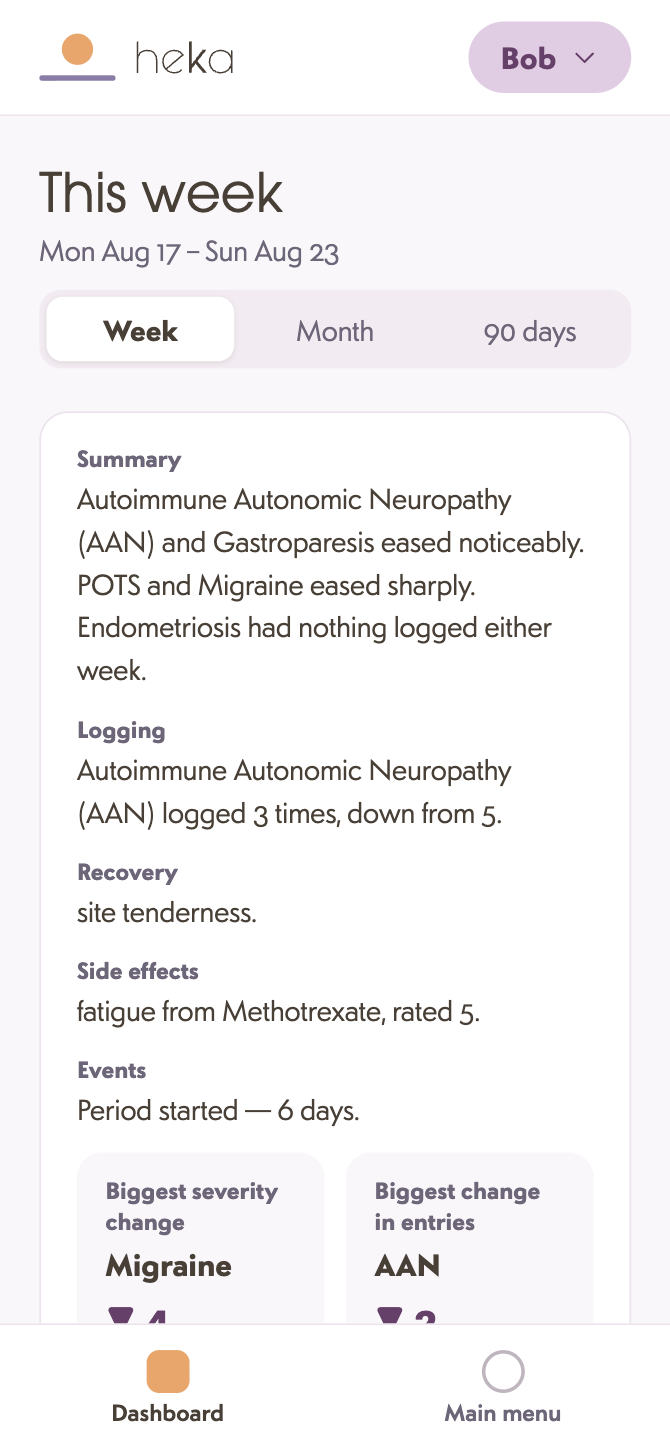
Your week, at a glance
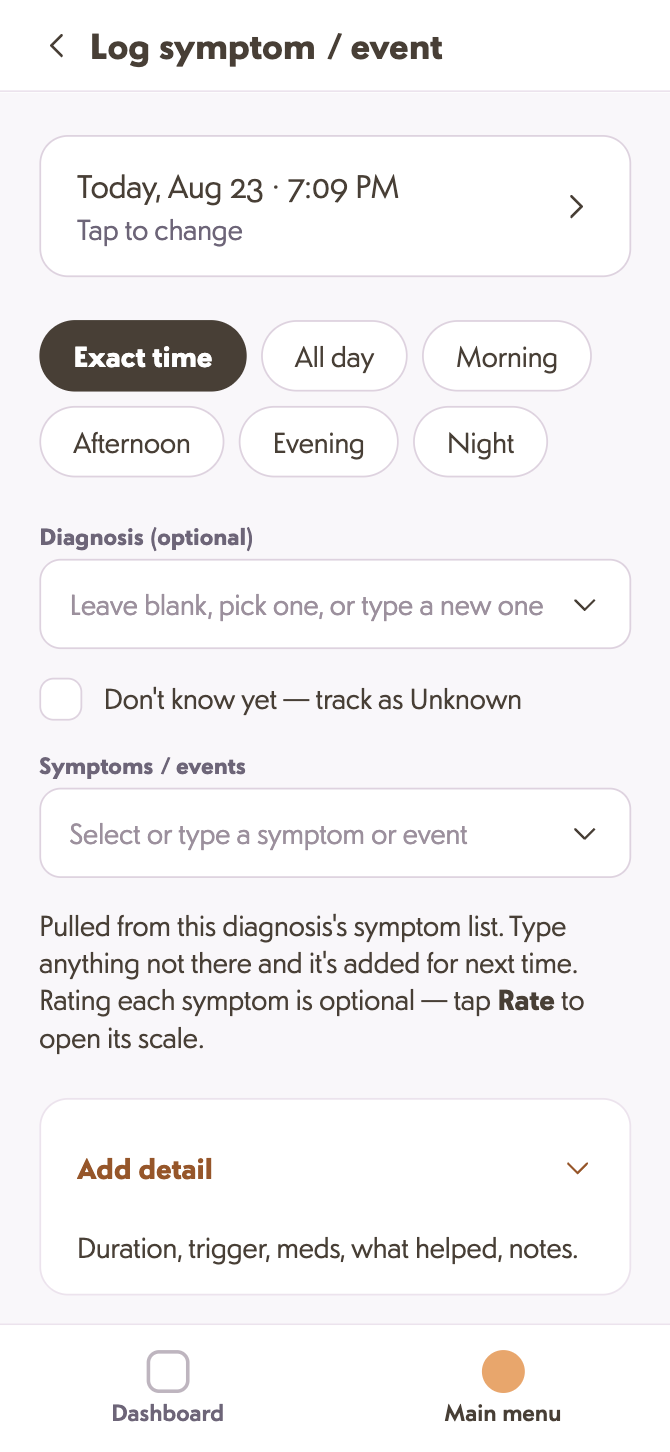
Three taps on a bad day
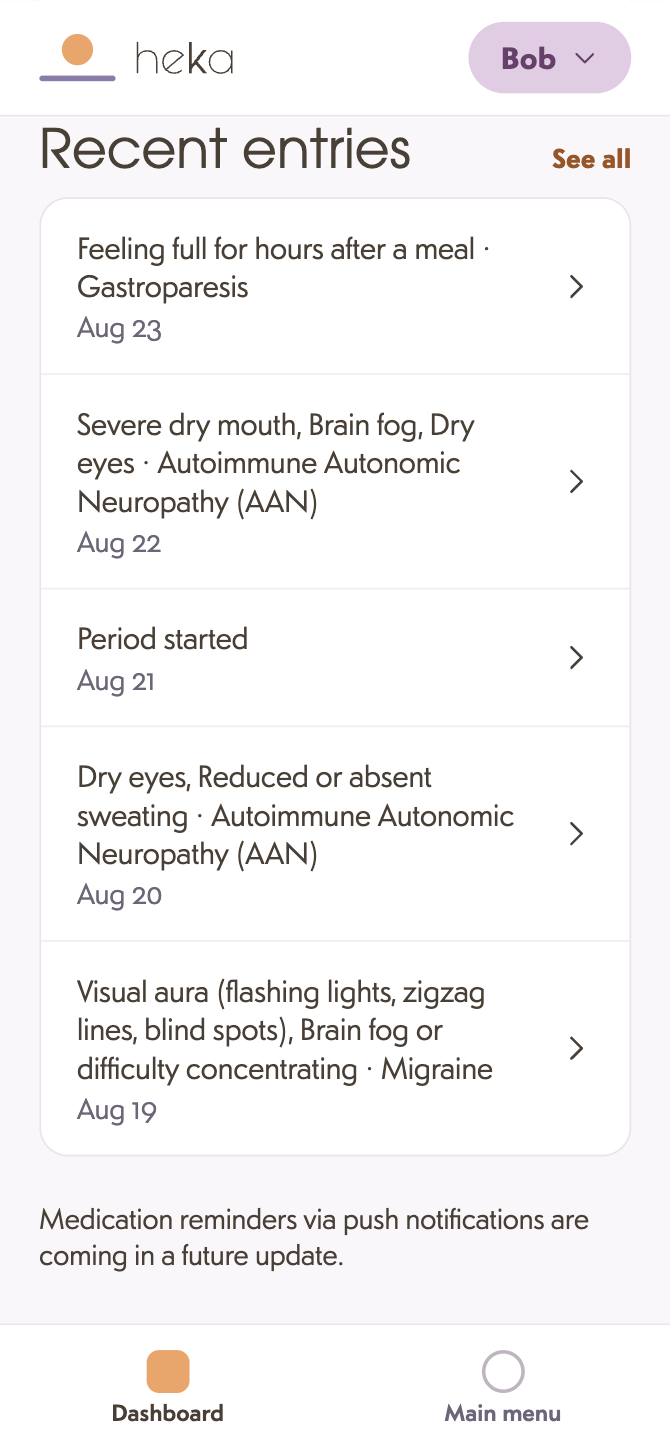
Everything, in order
Your data stays yours
This is data about your body, and we treat it with privacy and respect.
Encrypted, restricted, logged
Encrypted in transit and at rest. Access is restricted and every entry is logged.
Never sold, never shared
No data brokers. No third-party analytics reading your entries.
You'll know before anything changes
Policies change as products grow. When ours does, we'll tell you what's moving and where, before it happens.
If you're a clinician
Heka doesn't diagnose, score, or triage. It records what your patient reports which can include frequency, severity, timing, duration, medications taken, and suspected triggers then organizes it into a summary for the interval you ask for.
Patient-reported data, labeled as patient-reported.
No algorithmic interpretation layered on top.
Heka is an informational tool. It is not a medical device and makes no diagnostic claims.
Pricing
We haven't set it. The app isn't launched, and we'd rather say that than invent a number.
Join the waitlist and you'll hear it directly when it's decided.
Questions
Does Heka tell me what's wrong with me?
No, and it never will. It records what you log and analyzes the information to show the pattern. Interpretation is between you and your clinician.
What if my symptom isn't on the list?
Type it in. It's saved to your list, so it's there next time.
Can I group symptoms I think are related?
Yes. You don't need a diagnosis to connect them.
Can I track for someone else?
Yes. Household profiles cover a child, a parent, or a partner alongside your own. A profile can be transferred to that person later, with its full history.
Will my doctor actually read it?
It's designed for their convenience, not only will they read it, they will appreciate having all the context clues that will allow them to give you the best medical care possible.
When can I use it?
Our goal to be live this fall!
Help us get it right
Gain early access in exchange for telling us your thoughts, and letting us know if anything is broken.
There are limited testing spots available. We'll only use your address to contact you about testing and share when the Heka App launches.